
30 Sept 2026 · 7 min read
Evaluating Automotive Franchise Opportunities in Thailand: Insights for 2026
Explore the growing electric vehicle market in Thailand and the potential for franchising EV service centers in 2026.
EVS WorldwideRead
EVS Worldwide/Insights/Franchise
One in four new cars sold worldwide in 2025 was electric. What that means for an auto repair franchise, and how to judge an EV service franchise in 2026.
Yes, an auto repair franchise is still a good opportunity in 2026, but the strongest one is no longer built around oil changes. Electric car sales passed 20 million worldwide in 2025, one in four new cars sold, according to the IEA Global EV Outlook 2026. Those cars need less routine maintenance and more high-voltage diagnostics, battery health testing, software work and ADAS calibration. That shifts where the money in car repair sits, and it favours workshops that are trained and equipped for it.
Most lists of auto repair franchise opportunities still rank US brands built for petrol cars. This guide takes a worldwide view: where EVs are already mainstream, what they change inside the workshop, how a franchise compares with going independent or joining a dealer network, and what to check before you sign.
The traditional case for a car repair franchise rests on the size and age of the fleet. That still holds. What has changed is the mix of vehicles arriving at the workshop, and how quickly that mix is shifting in different parts of the world.
Source: IEA Global EV Outlook 2026, trends in electric cars. Electric cars include battery-electric and plug-in hybrids. Figures are the IEA's rounded shares.
A few points stand out for anyone weighing franchise opportunities in automotive service:
Globally, the IEA estimates that about 5% of the car stock is now electrified. That sounds small, but with one in four new cars now electric, the share of EVs in service bays can only rise as those cars age.
A traditional auto care franchise earns much of its steady revenue from scheduled maintenance. EVs remove a large part of that. The US Department of Energy's Alternative Fuels Data Center sums it up: all-electric cars have fewer fluids such as engine oil, far fewer moving parts, and "significantly reduced" brake wear because of regenerative braking. The battery, motor and electronics need little to no regular maintenance.
The work does not disappear. It changes shape:
The net effect, which we set out in detail in why EV service is a different business, is fewer routine jobs but more complex, higher-skill work that general garages often cannot take on.
There are three common routes into EV repair. Each suits a different owner.
| Factor | Franchise | Independent | Dealer |
|---|---|---|---|
| Brand | Established network | Build your own | Carmaker brand |
| EV training | Usually provided | Self-funded | OEM courses |
| Tools & data | Group access | Buy per brand | One brand, full |
| Makes served | Multi-brand | Your choice | Mostly one |
| Fees & control | Fees, set standards | Full control | OEM terms |
A franchise gives you a playbook: site specification, training, suppliers, systems and marketing. In return you pay fees and follow the network's standards. For EV work the playbook matters more than usual, because the safety and equipment requirements are hard to work out alone.
An independent workshop keeps all the margin and all the decisions. It also carries all the risk of buying multi-brand diagnostic tools, repair information subscriptions and high-voltage training one brand at a time.
A dealership has the deepest access to one manufacturer's data and parts, but it is tied to that brand's sales, standards and investment demands. Owners of older or less common EVs often look elsewhere once the warranty ends.
Whether you are comparing a traditional auto repair franchise with an EV service franchise, or two EV repair franchise networks with each other, these are the questions that separate a future-ready offer from a rebranded petrol garage:
Every network prices differently, and published figures change, so treat any number as a starting point for your own due diligence. The typical cost components of a car repair franchise are:
For a sense of scale in the US conventional market, AAMCO's franchise site listed a $45,000 franchise fee and an initial investment of $276,600 to $407,200 when we checked in September 2026, with $90,000 in liquid capital and $250,000 net worth required. That is one brand in one country; costs in other markets and for EV-focused centres will differ.
Technician qualifications are the other requirement. In the UK, the Institute of the Motor Industry offers electric and hybrid vehicle awards from Level 2 routine maintenance up to Level 4 diagnosis and repair of live high-voltage components. Its IMI TechSafe recognition is described as "evidence of being safe and qualified" to work on vehicles such as EVs. In the US, the ASE L3 Light Duty Hybrid/Electric Vehicle Specialist certification requires passing the A6 electrical and A8 engine performance tests first, and must be renewed every five years. Recruiting and keeping these people is often harder than finding a site, a point we make in what a specialist EV workshop needs.
The US has the biggest auto repair franchise industry and the most brands to choose from, but EV adoption is slower: about 10% of new car sales in 2025. The opportunity is concentrated in states with large plug-in fleets. We cover that in detail, with state-by-state data, in auto repair franchise in the US: the EV service opportunity.
The UK passed two million new car registrations in 2025, with 473,348 battery-electric cars, a 23.4% share, according to SMMT. Across Europe, 28% of new cars were electric. The skills framework is mature, with IMI qualifications widely recognised. See the United Kingdom market page.
The Middle East sold about 75,000 electric cars in 2025, up more than 40%, according to the IEA. The UAE is the largest market, while Qatar and Saudi Arabia together now account for nearly 45% of regional demand. Shares are still low: The National, citing industry sources, reported about 11,700 battery-electric cars sold in the UAE in 2025, around 3.4% of new car sales. That makes the Gulf a market where specialist capacity can be built ahead of demand. Read more in our GCC EV adoption signals for 2026 and on the UAE, Saudi Arabia and Qatar pages.
India sold 165,000 electric cars in 2025, nearly 4% of the market and up 75%, with domestic makers Tata and Mahindra producing roughly 60% of them, according to the IEA. The fleet is small but young and growing, and trained high-voltage technicians are scarce. See the India market page.
EVS Worldwide builds specialist EV service centres and is expanding through franchise partners. Here is what our franchise pages set out.
Hub and spoke, not identical shops. Deep capability is expensive, so it is concentrated. A hub handles complex diagnostics, battery opening and module repair, quarantine, ADAS, the fleet desk and regional training, with roughly five productive bays plus a dedicated isolation area. Satellites handle inspections, battery state-of-health tests, routine mechanical work, charging and thermal diagnosis and pack removal. Complex cases route to the hub rather than being turned away. Full details are on the franchise opportunity page.
How a centre launches:
| Stage | Timing | What happens |
|---|---|---|
| Market qualification | Weeks 1–4 | Fleet, service pool, competition, regulation |
| Anchor demand | Weeks 5–8 | Letters of intent from fleets, insurers |
| Technical leadership | Weeks 5–10 | Hire technical manager and HV lead |
| Site and fit-out | Weeks 9–16 | Fire, insurer, power and zoning checks |
| Launch and proof | Month 5 on | Twelve-month proof period |
EVS approves a centre on contracted local demand and secured technical leadership. The proof period tracks first-time-fix rate, gross profit per bay-hour, cycle time and SLA performance.
How partners and EVS earn. Partners earn workshop labour across diagnostics, high-voltage, mechanical and ADAS work; parts revenue with group procurement terms; B2B contract and retainer revenue from fleet and insurer accounts; and inspection and certification products such as battery state-of-health reports. EVS earns initial training and fit-out fees, recurring platform, software and QA fees, and parts margin through central procurement.
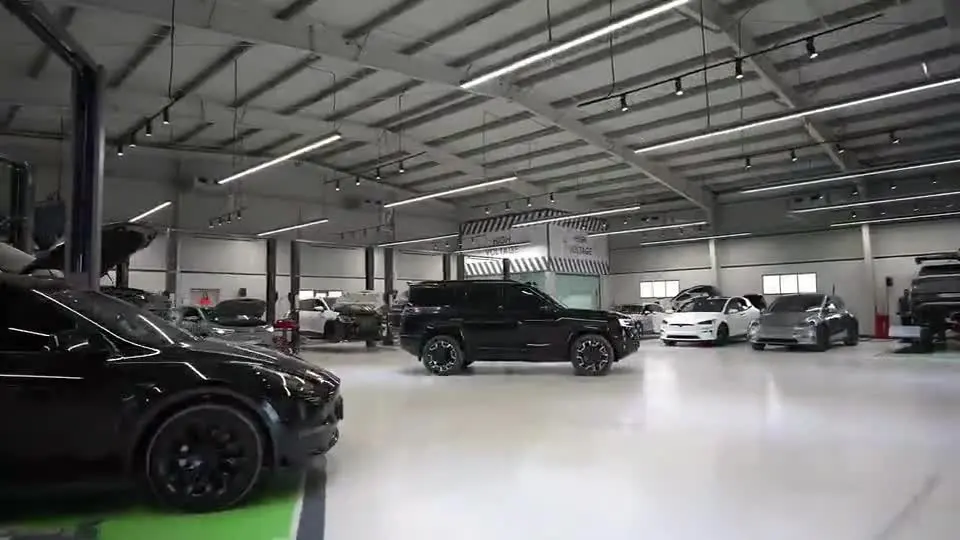
The workshop. The workshop setup page specifies lifts rated for EV kerb weight, an access-controlled high-voltage bay, battery quarantine designed before the lease is signed, an ADAS calibration area, a multi-brand diagnostics station and traceable parts storage. Technicians work to three capability tiers, from HV-aware to a specialist HV lead with trained support technicians.
Marketing. Under the line "You run the workshop. We fill the bays," marketing support includes a localised EVS website, service and location pages, booking and WhatsApp enquiry routing, launch campaigns, monthly content and an approved asset hub.
Where EVS operates. EVS runs service centres in the United Arab Emirates, Saudi Arabia, Oman and Qatar, with Bahrain, Iraq and Bangladesh listed as opening soon. See all EVS locations.
It can be, but results depend on the brand, location, fees and your own management. The market case is strongest for workshops that can service EVs, because routine maintenance per car is falling while complex high-voltage, software and calibration work is growing. Always review the full disclosure documents and speak to existing franchisees.
A conventional auto repair franchise is built around petrol and diesel work such as oil changes, exhaust, transmission and brakes. An EV service franchise is built around high-voltage safety, battery diagnostics, thermal and charging systems, software and ADAS, with the equipment, layout and training that work requires.
It varies widely by brand and country. Typical components are the franchise fee, premises and fit-out, equipment, software and data subscriptions, training, working capital and ongoing fees. As one US example, AAMCO's franchise site listed an initial investment of $276,600 to $407,200 in September 2026.
Not always as the owner, but the centre needs qualified technical leadership. EVS, for example, requires a technical manager and high-voltage lead to be secured before a centre is approved.
It depends on the country. In the UK, IMI electric and hybrid vehicle awards at Levels 2 to 4 and IMI TechSafe recognition are widely used. In the US, ASE offers the L3 Light Duty Hybrid/Electric Vehicle Specialist certification. Check local health and safety rules for high-voltage work too.
Markets with large or fast-growing EV fleets and few specialist workshops. China and Europe have the largest fleets; Southeast Asia, India and the Middle East are growing fastest. Our market intelligence pages break the numbers down by country.
Often, if the site can accommodate a separate high-voltage bay, battery quarantine and a calibration area, and the team can be trained. Quarantine and pack flow should be planned before committing to a site, not retrofitted.
EVS currently operates in the UAE, Saudi Arabia, Oman and Qatar, with Bahrain, Iraq and Bangladesh opening soon. If you are looking at another market, tell us which one.
If you are weighing auto repair franchise opportunities and want to understand what an EV-focused centre would look like in your market, send us an enquiry. Tell us which market you are looking at and we will send the relevant market intelligence and the franchise pack.
01 / The research behind this
Fleet size, addressable service revenue, competition, incentives and a 90-day entry plan — free on request for qualified franchise enquiries.
02 / Related reading
30 Sept 2026 · 7 min read
Explore the growing electric vehicle market in Thailand and the potential for franchising EV service centers in 2026.
23 Sept 2026 · 6 min read
Explore the potential for automotive franchise opportunities in Germany's EV service sector, with insights on market dynamics and investment considerations.
21 Sept 2026 · 7 min read
Explore the operating costs of EV service centres versus traditional workshops in 2026. Understand the financial implications for franchise partners.
03 / Not in your country yet?
Tell us your territory. We'll send the market research alongside the franchise pack and connect you with the team behind every EVS centre.