Fleet & B2BThe uptime playbook: keeping an electric fleet earning
A parked EV is a depreciating asset with a payment plan. How fleet operators structure servicing so downtime, not distance, drives the maintenance calendar.
United Arab Emirates EV Service Centre Market Entry
Decision-grade assessment of the UAE BEV/PHEV aftersales market and the case for controlled EVS home-market scaling.
Verdict: go for controlled home-market consolidation—strengthen the Dubai–Abu Dhabi company-operated spine and validate a Sharjah/Northern Emirates spoke; do not franchise the UAE operating market. Dubai had 47,944 registered EVs at end-2025, up 27.9%, while Abu Dhabi exceeded 15,000 registered EVs in Q1 2025. EVS already has home-market capability, but incomplete federal powertrain data, a young warranty-heavy parc and rapid OEM/independent competition require disciplined scope and audit gates. Dubai Abu Dhabi
Approve staged scaling: consolidate the existing Dubai technical flagship, standardise the Abu Dhabi operating cell and run a 90-day paid Sharjah/Northern Emirates collection-and-triage pilot. Require two fleet/insurer anchors, 150 paid incremental jobs, quality thresholds and a path above AED9.0 million annual spoke revenue before a permanent site.
The best defensible public service floor is 62,944 registered EVs: Dubai’s 47,944 at end-2025 plus Abu Dhabi’s “more than 15,000” in Q1 2025. The emirates do not overlap, but the dates differ and the Abu Dhabi figure is rounded; the sum is a conservative multi-emirate floor, not a federal active-stock census.
No current public federal table cleanly separates active BEV and PHEV stock across all seven emirates. Core TAM therefore uses the registered-EV floor only. PHEV sales and service needs are covered operationally but unknown PHEV stock is never invented or added.
Federal open data provides registered vehicles by emirate and vehicle type through 2024, but not a current powertrain split. Secondary industry reporting has placed the overall UAE parc above 3.6 million with an average age near six years; this is broad aftermarket context and is excluded from TAM.
Official emirate figures; combined floor uses mixed dates and is not a federal census.
“EV” in Dubai and Abu Dhabi releases is treated as registered electric vehicles; neither release supplies a BEV/PHEV split. National-policy targets refer to the share of EVs on roads, while some procurement targets combine electric and hybrid vehicles. These populations are not mixed.
| Metric | Value | Scope | Use |
|---|---|---|---|
| Dubai registered EVs | 47,944 | End-2025 DEWA release | Service-floor component |
| Abu Dhabi registered EVs | >15,000 | Q1 2025 Abu Dhabi Mobility | Service-floor component |
| Multi-emirate floor | 62,944 | Non-overlapping emirates, mixed dates | TAM denominator |
| PHEV stock | Unavailable | No current comprehensive public split | Excluded from TAM |
| Dubai charging | >1,860 points | DEWA plus licensed operators | Infrastructure |
Industry-sourced UAE new-car data reported approximately 11,700 BEV sales in 2025, down from 12,400 in 2024, while PHEVs rose to about 1,100 from 200. Total new-car sales were just under 345,000, placing BEVs near 3.4%. The figures are not an official registration release and are labelled accordingly. The National
PHEV growth reflects range, charging-access and heat/range-anxiety concerns. EVS should retain integrated combustion, fuel, emissions and thermal competence; PHEVs are a service segment, not a stock input until an authoritative active-parc count is obtained.
Dubai’s official stock increased from 37,486 at end-2024 to 47,944 at end-2025, a 27.9% rise. Abu Dhabi separately reported more than 15,000 EVs in Q1 2025, 60% above the comparable prior-year period. Stock growth and national sales flows are separate measures.
Secondary industry-source national sales; not official register data.
In May 2026, MoEI said the UAE accounted for nearly 50% of Middle East EV sales for a second consecutive year, citing the IEA Global EV Outlook 2026. This establishes regional leadership but does not supply a national unit total, so it is not used in sizing. MoEI
The official Dubai stock trend is stronger than the secondary national BEV sales flow. This may reflect imports, used/grey vehicles, re-registration timing, geographic mix or source coverage; EVS does not force the series to reconcile.
From the 62,944 multi-emirate floor, EVS applies five years of 18%, 25% and 32% CAGR. Cautious, base and high cases reach approximately 144,001, 192,090 and 252,246 EVs by end-2030.
These are EVS planning scenarios, not official forecasts. The 2050 federal target, Dubai/Abu Dhabi charging build-out, fleet procurement and model proliferation support growth; low fuel prices, warranty capture, apartment charging and resale uncertainty constrain it.
Planning cases from conservative floor; not official forecasts.
| Scenario | 2030 registered-EV floor | CAGR | Interpretation |
|---|---|---|---|
| Cautious | 144k | 18% | Fuel, warranty and apartment-charging drag |
| Base | 192k | 25% | Steady model and infrastructure growth |
| High | 252k | 32% | Fleet mandates and regional leadership |
Dubai exceeded 1,860 charging points at end-2025, including DEWA, subsidiaries and licensed private operators. Abu Dhabi’s Charge AD first phase calls for 1,000 stations at 400 locations, while Barq adds more than 50 360kW chargers. Planned stations are never counted as operational stock.
Dubai’s public tariff is AED0.70/kWh for AC and AED1.20/kWh for DC, plus VAT. Abu Dhabi published the same standardised Charge AD tariffs. Price parity does not imply network interoperability, uptime or equivalent access.
Dubai requires CPO licensing under DEWA’s framework; Abu Dhabi operates under its Department of Energy charging policy and Charge AD programme; UAEV addresses national corridors. Charging is regulated locally and federally rather than through one workshop licence.
Network growth raises demand for onboard-charger, charge-port, 12V, thermal and vehicle-versus-charger diagnosis. EVS should partner with CPOs for referrals but exclude ownership of public charging assets from the workshop case.
The official EV fleet is young, but UAE heat, dust, high-speed driving, accident exposure and intensive fleet cycles create immediate demand in thermal systems, tyres, suspension, brakes, cooling, 12V systems, charging and battery evidence before traction-pack ageing peaks.
Grey imports, Chinese-brand expansion, premium out-of-warranty EVs, rental/fleet rotation, insurer/body-shop escalation and used-EV transactions are the strongest independent-service demand pools. Rapid resale and export cycles make traceable battery evidence particularly valuable.
EVS models an annual TAM of AED79.3 million: 62,944 sourced vehicles × 0.70 paid jobs per vehicle × AED1,800 average ticket. Frequency and ticket are EVS assumptions. Applying 55% independent eligibility and 85% geographic/service fit produces a modelled AED37.1 million SAM.
| Layer | Formula | Vehicles/jobs | Annual revenue | Evidence |
|---|---|---|---|---|
| TAM | 62,944 x 0.70 x AED1,800 | 63k | 79.31m | Sourced floor; EVS frequency/ticket assumptions |
A scaled spoke/base SOM of 5,000 jobs × AED1,900 = AED9.5 million annual revenue equals 25.6% of modelled SAM. It is a capacity and acquisition test, not a forecast.
Prioritise premium and Chinese-brand owners, used-EV dealers/buyers, insurers/body shops, rental and corporate fleets, taxi/ride-hail operators, independent-garage referrals and CPO/roadside partners. Arabic/English service evidence and collection logistics are core capabilities.
| Priority | Segment | Need |
|---|---|---|
| 1 | Used-EV dealers and buyers | Battery and GCC/grey-import evidence |
| 2 | Insurers and body shops | Isolation, damage classification and escalation |
| 3 | Rental, taxi and corporate fleets | Uptime and SLA |
| 4 | Premium and Chinese-brand owners | Cross-brand diagnosis |
| 5 | Independent garages | HV/PHEV referrals |
| 6 | CPO and roadside operators | Vehicle-versus-charger triage |
Tesla Model 3/Y anchor the visible new and used BEV market, while BYD, Zeekr, MG, Geely/Polestar, Volvo, BMW, Mercedes EQ, Porsche Taycan, Audi e-tron, Hyundai/Kia and Lucid broaden the parc. Public model rankings are incomplete, so no unsupported national shares are asserted.
PHEV/REEV scope should include BYD DM-i families and premium German/Volvo platforms, with strong combustion and thermal competence. Grey-market Xiaomi, Avatr, Aito and other Chinese vehicles require VIN, GCC-spec, parts and software gates.
New authorised entrants such as Aito strengthen OEM competition while creating future out-of-warranty demand. EVS must distinguish GCC-authorised, imported GCC-spec and non-GCC grey vehicles in every estimate and warranty statement.
| Priority | Platform | Evidence | Launch scope |
|---|---|---|---|
| 1 | Tesla Model 3/Y/S/X | Visible new and used BEV anchor | Battery, charging, chassis and evidence |
| 2 | BYD Seal/Atto 3/Han/Song/DM-i | Rapid authorised Chinese expansion | BEV/PHEV integrated diagnosis |
| 3 | Mercedes EQ/BMW i/Audi e-tron/Porsche Taycan | Premium ticket and out-of-warranty base | Programming, thermal and battery evidence |
| 4 | Volvo/Polestar/Zeekr | Premium Geely-family growth | Cross-brand evidence |
| 5 | MG/Hyundai/Kia/Lucid | Broadening authorised parc | VIN/function gated |
| 6 | Grey Xiaomi/Avatr/Aito/other Chinese | Import and software complexity | Strict GCC/parts/tool gate |
EVS competes with Tesla and authorised dealer groups on warranty/data/parts, Bosch Car Service and general independents on convenience, and EV specialists/charging platforms such as PlusX on mobile and charging services. EVS’s defensible edge is established cross-brand HV depth, battery diagnostics, programming, transparent scopes and insurer/fleet governance.
| Competitor | Type | Strength | EVS response |
|---|---|---|---|
| Tesla and authorised OEM dealer groups | OEM | Warranty, parts, recalls and proprietary data | Out-of-warranty, grey-import and cross-brand evidence |
| BYD/Chinese authorised networks | OEM | New warranty-heavy platforms | Future independent depth and overflow |
Dubai remains the scale and premium hub; Mussafah/Khalifa City serves Abu Dhabi fleets and owners; Sharjah Industrial Area–Al Sajaa is the best incremental spoke for Sharjah, Ajman and northern-Dubai demand. Al Ain and the Northern Emirates should begin with collection/mobile triage and referrals.
| Cluster | Demand | Talent | Cost feasibility | B2B | Recommendation |
|---|---|---|---|---|---|
| Dubai Investment Park–Dubai South–Jebel Ali | 5 | 5 | 4 | 5 | Consolidate technical flagship |
The UAE offers policy support, public charging and emirate-specific parking/toll/registration measures, but benefits change. EVS assumes no universal federal cash purchase subsidy and does not market expired historical benefits.
Dubai charges public electricity and requires an AED500 EV-account security deposit for registered individual/business users. Abu Dhabi’s August 2025 DARB update restated current toll rules without restating the older EV exemption; eligibility requires live confirmation.
Government and fleet procurement targets—such as Dubai’s increasing electric/hybrid share and taxi transition—are more decision-relevant to EVS than retail rebates. They create B2B service opportunities but do not guarantee independent access.
| Programme | Value | Scope |
|---|---|---|
| Universal federal purchase subsidy | None assumed | Verify live programmes |
| Public charging tariff | AED0.70 AC / AED1.20 DC per kWh + VAT | Dubai; Charge AD announced same tariff |
Model 5% VAT, federal corporate tax, customs, payroll/immigration, related-party and free-zone/mainland rules with UAE advisers. Small Business Relief has an AED3 million revenue test and exclusions; a scaled EVS hub should not assume eligibility.
No dedicated independent-workshop subsidy is assumed. Free-zone incentives may not suit customer-facing mainland repair activity, and Qualifying Free Zone Person treatment requires exact activity/income analysis. Obtain written tax and licensing advice before restructuring.
Use licensed UAE operating entities and premises matching the automotive-repair activity, with beneficial-owner, immigration, WPS, VAT/corporate-tax, insurance and intercompany/IP controls. EVS home-market governance should remain company controlled.
Workshop activities, land use, tenancy, municipality, Civil Defence, environmental/waste and signage approvals are emirate and zone specific. Dubai mainland and Abu Dhabi/Mussafah sites require separate approval matrices; no lease should precede written activity/site confirmation.
Charging licences do not authorise vehicle repair, and workshop licences do not authorise public CPO operations. Battery storage, salvage, transport, body work, paint and refrigerant handling may require additional approvals.
The UAE has no single stand-alone franchise statute. Franchise/licence arrangements must be analysed under contract, commercial-agency, competition, trademark, consumer, tax and data rules. Home-market operations should not be franchised before auditability is proven.
Federal labour/OSH duties require a safe workplace, training, PPE, emergency planning and records. EVS should adopt manufacturer-grade HV controls and international good practice because generic workshop rules do not by themselves constitute EV-specific competence.
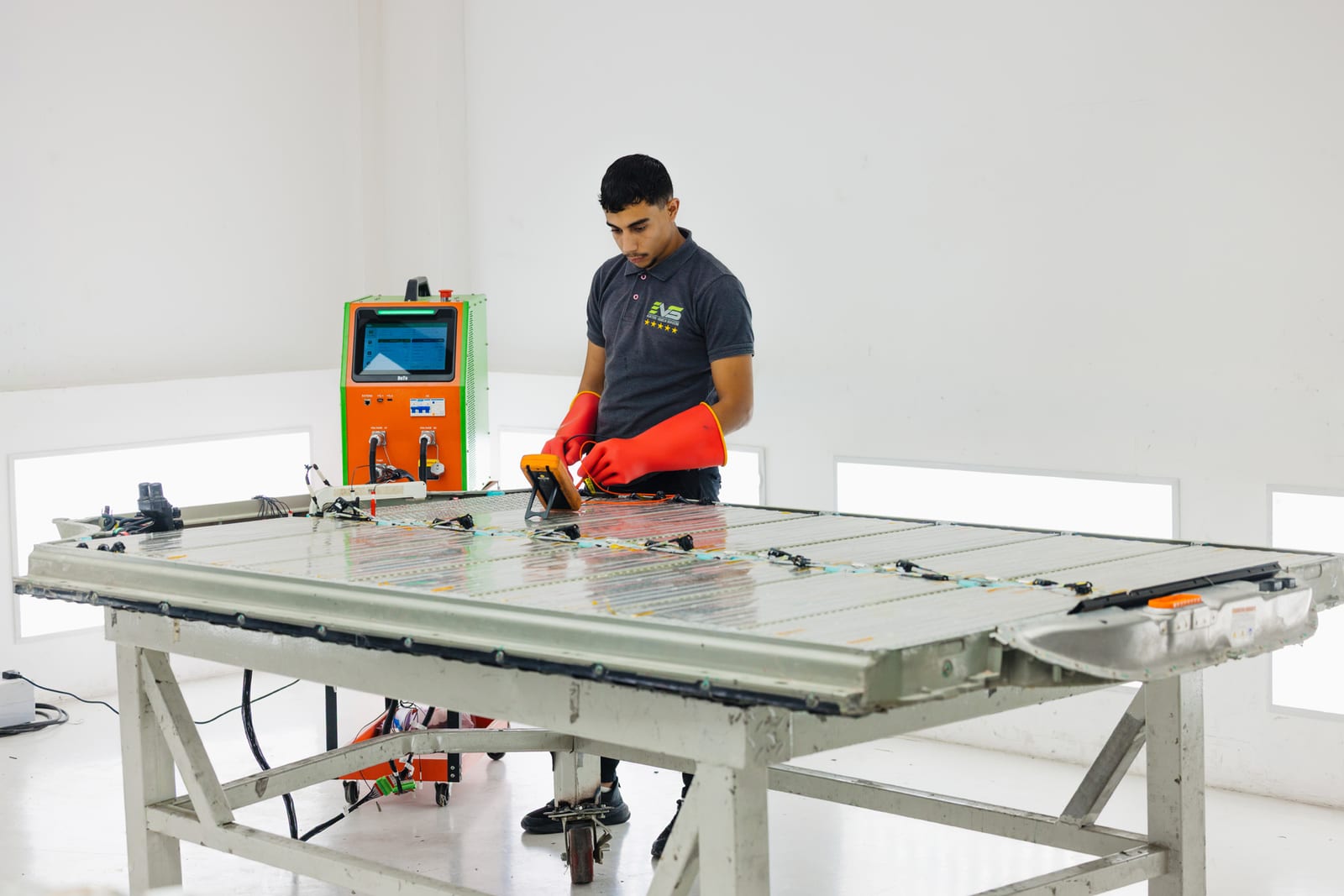
Require named authorised persons, role matrices, lockout/tagout, prove-dead sequence, insulated PPE/tools, calibrated meters, heat-aware work/rest, rescue plan, quarantine, thermal monitoring and bilingual records. Pack opening remains separately gated.
The UAE can recruit internationally but faces visa, wage, retention and genuine multi-brand diagnostic-skill constraints. EVS should formalise an academy, competency passports, Arabic/English customer training and Emiratisation planning rather than relying on certificates alone.
The BEEAH–LOHUM recycling project improves local end-of-life options but does not itself authorise workshop storage or transport. Require written acceptance, UN-compliant logistics, insurer/Civil Defence approval and a damaged-battery quarantine procedure.
Classify traction batteries, 12V batteries, oils, coolants, refrigerants, tyres, contaminated absorbents and electronics under the applicable emirate/federal rules. Use licensed carriers and facilities with manifests; Dubai and Abu Dhabi chains differ.
Use refrigerant identification, recovery and leak controls suitable for each platform. Confirm tool, storage, technician and environmental requirements for R134a, R1234yf, CO2 and any imported-platform refrigerant before service.
Diagnostic logs, telematics, CCTV, call recordings, Emirates ID, fleet and remote-support data require purpose limitation, security, retention, processor and cross-border-transfer controls under Federal Decree-Law 45/2021 and relevant free-zone regimes.
| Area | Requirement | Gate |
|---|---|---|
| Company/tax | Correct mainland/free-zone entity, activity, VAT/CT, UBO, WPS and immigration | Before trading |
| Workshop/site | Land use, tenancy, municipality, Civil Defence, environmental and signage matrix | Before lease |
Scale battery-health and pre-purchase evidence; charging/thermal/HV diagnosis; programming and calibration where lawful; PHEV integrated diagnosis; tyres, brakes, suspension and 12V; collision isolation; mobile/collection triage; fleet SLAs; and warranty/insurer evidence. Defer cell repair and salvage packs.
| Phase | Service | Condition |
|---|---|---|
| Scale now | Battery-health and pre-purchase evidence | Validated tools and GCC/grey disclosure |
| Scale now | Charging, thermal and HV diagnosis | Authorised staff and platform proof |
| Scale now | Programming/calibration where lawful | Function and subscription proof |
| Scale now | PHEV integrated diagnosis | Combustion plus HV controls |
| Scale now | Tyres, chassis, brakes, AC and 12V | EV lift and heat procedures |
| Scale now | Collision isolation and fleet SLA | Insurer/fire/quarantine protocol |
| Phase 2 | Pack-level diagnosis | Fire, waste, insurance and demand gates |
| Exclude initially | Cell/module repair and salvage packs | Separate investment decision |
Keep UAE centres company controlled as EVS’s training, QA, data and technical reference market. Use one national operating standard with emirate-specific licensing appendices, central remote diagnosis, calibrated equipment control and quarterly safety audits.
The UAE flagship network should prove the franchise system for export: academy curriculum, bill of materials, service taxonomy, warranty, insurer SLAs, data controls and audit scorecards. It should not itself be diluted through a UAE master franchise.
The base spoke case assumes 5,000 jobs, AED1,900 average ticket, 58% contribution margin and AED5.2 million fixed cost, producing AED310,000 EBIT. Break-even revenue is AED8.97 million. All inputs require current quotations and incremental paid-job evidence.
EVS assumptions in AED; EBIT in tooltip.
| Scenario | Jobs/year | Average ticket | Revenue | EBIT |
|---|---|---|---|---|
| Low | 3,000 | 900 | 2.7m | -2.98m |
Highest risks are warranty capture, OEM/grey-import data and parts, rapid platform proliferation, heat-related battery events, workshop/fire/waste compliance, insurer liability, talent retention, price competition and cannibalisation of existing EVS sites. Each has an explicit gate.
| Risk | Likelihood | Impact | Mitigation |
|---|---|---|---|
| Young warranty-heavy parc | High | High | Used-EV, grey-import and B2B focus |
| OEM data/parts control | High | High | Function-by-function proof |
| Grey-import software/parts | High | High | GCC/VIN/parts gate |
| Heat and battery event | Medium | Severe | Thermal protocol and no-cell launch |
| Emirate licensing variance | Medium | High | Written site matrices |
| Talent retention | High | High | Academy and competency passport |
| Price competition | High | Medium | Evidence and SLA differentiation |
| Cannibalisation/premature franchise | Medium | High | Incremental-job gate and company control |
Days 1–30 — map incremental demand. Audit existing EVS UAE capacity and catchments, complete three Sharjah/Northern Emirates site/licence screens, interview 30 fleets/insurers/dealers, map ten platforms and price collection/mobile services.
Days 31–60 — test without permanent capital. Operate a compliant temporary/partner bay and collection route, train staff, test platform functions, sign waste/insurance terms and launch paid B2B/used-EV service packages.
Days 61–90 — prove incrementality. Reach 150 paid incremental jobs, two anchors, quality gates, collection economics and signed site quotations. Approve permanent spoke only if it adds demand rather than shifting existing EVS work.
| Gate | Threshold | Failure action |
|---|---|---|
| Legal site path | Activity, land use, fire, tax and waste matrix accepted | No lease |
Evidence was searched and accessed on 8 August 2026, prioritising MoEI, UAE government, DEWA, Abu Dhabi Mobility/DoE, FTA, RTA, official statistics, laws and official operator/OEM pages. EVS separates official stock, secondary sales, targets, plans and assumptions.
A current federal BEV/PHEV register, emirate-level PHEV stock, model parc, independent share, EVS internal capacity/cannibalisation, labour/site quotations, platform access, battery-receiver terms and willingness to pay require primary validation. Forecasts and economics are scenarios.
| Topic | Confidence | Required validation |
|---|---|---|
| Current federal BEV/PHEV active stock | Medium-low | Obtain MOI/emirate powertrain extract |
| PHEV stock and model parc | Low | Registration, insurer and OEM extract |
| Independent aftersales share | Low | Fleet/insurer/workshop interviews |
| EVS internal capacity and cannibalisation | Low | Branch/job catchment analysis |
| Platform secure-function access | Low | Ten-platform live test |
| Site/labour economics | Low | Signed quotations and offers |
| Battery receiver/insurer terms | Low | Written acceptance and SLAs |
| Calculation | Expression | Result | Status |
|---|---|---|---|
| Multi-emirate service floor | 47,944 + 15,000 | 62,944 | passed-conservative |
| Dubai stock growth | 47,944 / 37,486 - 1 | 0.279 | passed-rounded |
| TAM | 62,944 x 0.70 x AED1,800 | 79,309,440 | passed |
| Eligible pool | TAM x 55% | 43,620,192 | passed |
| SAM | Eligible x 85% | 37,077,163.2 | passed |
| Base revenue | 5,000 x AED1,900 | 9,500,000 | passed |
| Base EBIT | AED9.5m x 58% - AED5.2m | 310,000 | passed |
| Break-even revenue | AED5.2m / 58% | 8,965,517.24 | passed-rounded |
| Pilot share of SAM | AED9.5m / SAM | 0.256 | passed |
| 2030 base floor | 62,944 x 1.25^5 | 192,090 | passed-rounded |
The source registry records publisher, publication date, access date, link and use note. Current regulations, benefits, licences and tariffs must be rechecked immediately before action.
Decision: scale the UAE as EVS’s controlled reference market. Consolidate Dubai–Abu Dhabi, validate a Sharjah/Northern Emirates spoke, and keep pack work, permanent capital and any franchise structure behind legal, safety, incremental-demand, quality and economics gates.
62 primary and derived sources
The complete assessment — competitive matrix, location shortlist, incentive and regulatory detail, pilot-centre economics and the 90-day entry plan. Sent straight to your inbox.
Fleet & B2BA parked EV is a depreciating asset with a payment plan. How fleet operators structure servicing so downtime, not distance, drives the maintenance calendar.
Market IntelligenceThe Gulf's EV story is running ahead of its stereotype. Fleet electrification, Chinese marques and government mandates are rewriting the service map.