
20 Nov 2026 · 12 min read
Car Repair Franchise in Vietnam: EV Competition
Assess Vietnam’s EV aftersales landscape, the key competitors and what franchise partners should weigh before entering this car repair franchise opportunity.
EVS WorldwideRead
EVS Worldwide/Insights/Franchise
Capability, capital, people and work mix — what it actually takes to open an EV repair shop, and the assumption that stalls most conversions from a conventional workshop.
The demand case for an EV repair shop no longer needs arguing. Electric cars are a mainstream share of new sales in most large markets, the first big cohorts are coming out of warranty, and the independent aftermarket that should be absorbing that work largely cannot.
The harder question is the practical one: what does it actually take to open one, and why do so many conversions from conventional workshops stall?
This guide sets out the four things that decide it — capability, capital, people and work mix — and the single assumption that sinks more projects than any other.
Global EV stock has grown to the point where aftersales is the constraint rather than sales. The IEA's Global EV Outlook tracks a fleet now measured in the tens of millions, and the cars sold in the 2020-2023 boom are exactly the ones leaving manufacturer cover now.
At the same time, the labour side is tightening. The US Bureau of Labor Statistics projects steady replacement demand for automotive service technicians while noting the growing need for workers trained on electric and electronic systems specifically. Across Europe, the Institute of the Motor Industry has spent years warning about the gap between the number of EVs on the road and the number of technicians qualified to work on them safely.
That gap is the business. It is not a gap in willingness — plenty of workshops want this work. It is a gap in three specific capabilities most of them do not have.
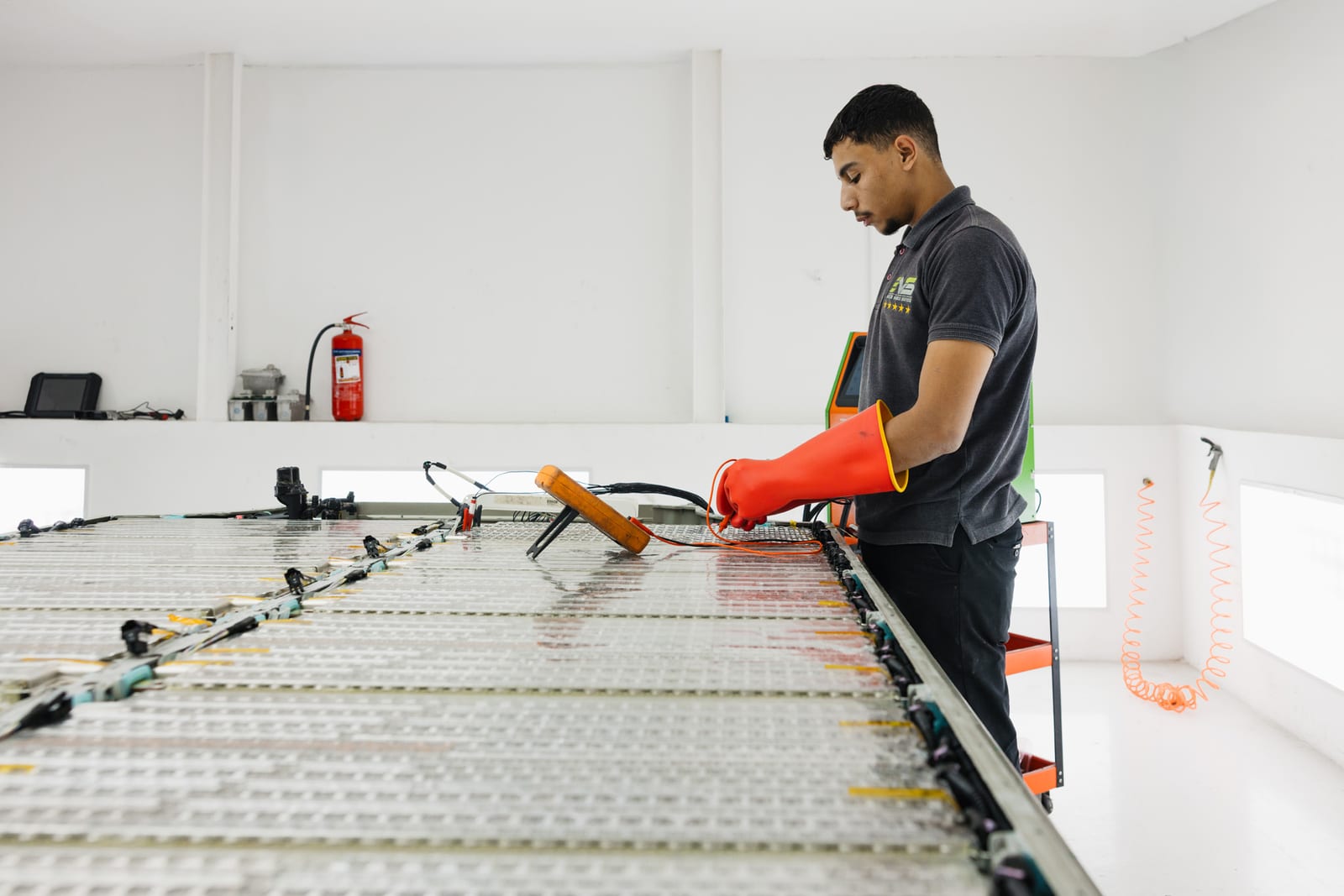
This is the hard boundary between a general garage that "also does EVs" and an EV workshop. Working on a live high-voltage system requires trained, certified technicians, insulated tooling, a defined isolation procedure, a quarantine area for damaged packs, and documented records of every high-voltage intervention.
Certification routes differ by market — the IMI's framework in the UK, ASE credentials in the US, manufacturer and national schemes elsewhere — but the principle is identical everywhere: without it, you cannot legally or safely do the work that carries the margin.
An EV reports very little useful information to a universal scan tool. Cell-level voltages, thermal data, calibration values and module parameters generally require platform-specific access. A workshop without it is limited to changing parts and hoping — which is expensive, slow, and the fastest way to lose a customer.
This is also where the brand coverage question gets decided. The platforms you can read determine the cars you can accept, and that is a commercial decision more than a technical one.
After a windscreen replacement, a collision repair, a suspension change or a ride-height adjustment, the cameras and radar need recalibrating. A workshop that cannot finish that step returns a car that looks repaired with its sensors pointing at the wrong place.
This capability is a genuine moat. It requires space, targets, equipment and procedure, and it is the single most common reason an EV job has to be sent elsewhere — which means it is also the most common reason a customer ends up at the workshop that can do it.
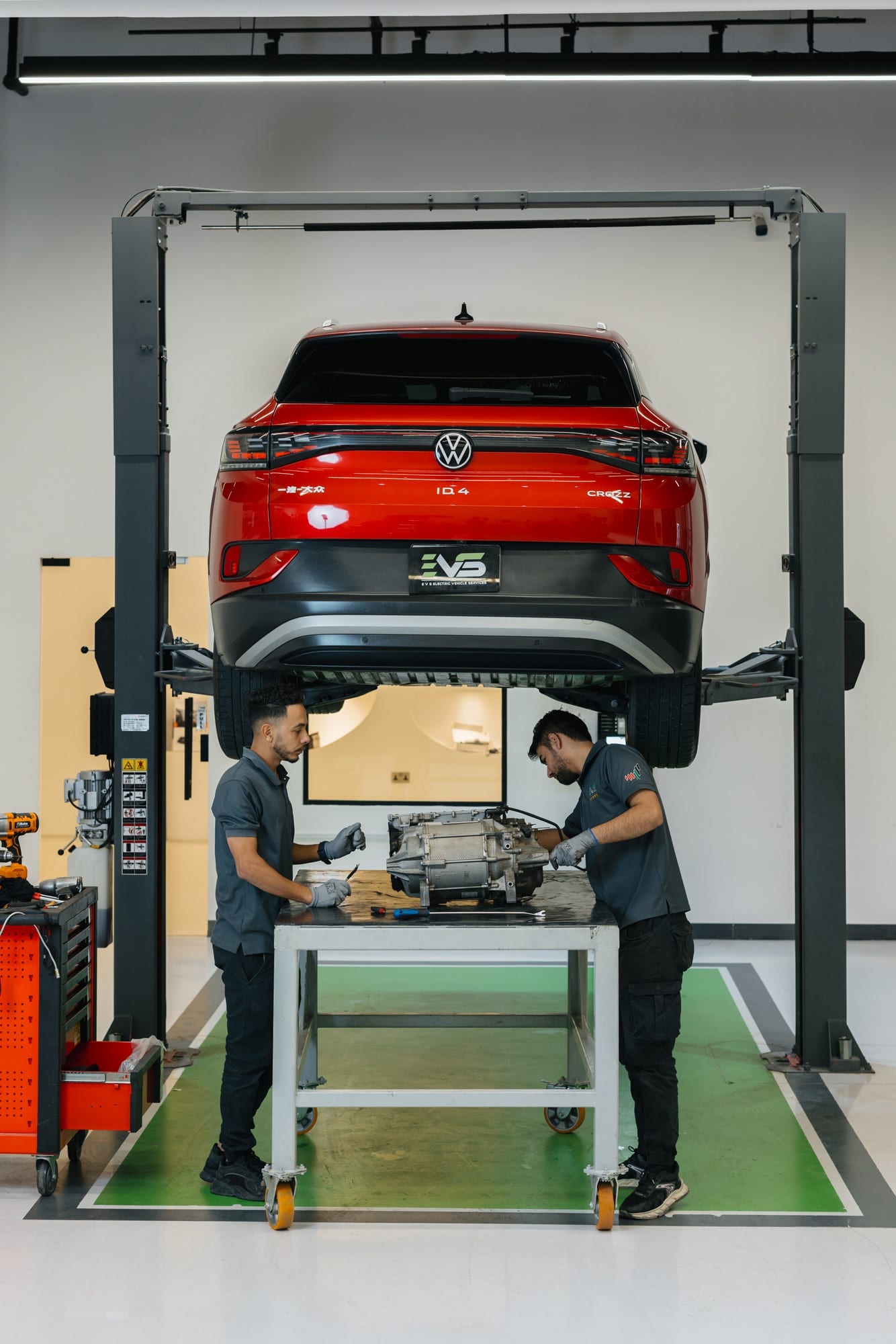
Beyond a standard workshop fit-out, the EV-specific list is short but non-negotiable:
The last one deserves emphasis. The difference between a workshop that replaces packs and one that repairs modules is the difference between quoting a five-figure bill and a four-figure one. It is the main reason customers choose an independent over a dealer, and the main reason they come back.
Here it is: assuming EV work is a smaller version of conventional work.
It is a different shape. Conventional servicing is high-frequency, low-value and distance-based — oil, filters, belts, brakes, repeated every few months. EV work is low-frequency, high-value and diagnostic-led. There is no oil change to bring someone through the door four times a year.
Three consequences follow, and planning that ignores them produces a workshop that is busy at the wrong things:
Your revenue per visit is higher and your visit count is lower. A business model built on throughput volume will under-perform; one built on diagnostic depth and correct first-time repair will not.
Diagnosis is the product, not a free preamble. The thing customers cannot get elsewhere is a measured answer — battery state of health with cell-level data, thermal circuit efficiency under load, a written finding. Giving that away free because conventional workshops do trains customers to value the parts instead of the expertise.
Hybrids and plug-in hybrids carry the business in the early years. In most markets there are far more of them than full EVs, and each one needs both an engine schedule and a high-voltage schedule. General garages take the engine half and miss the battery; EV-only shops do the reverse. Covering both is what keeps bays busy while the pure-electric parc grows into them.
Equipment can be bought in weeks. A technician who can read a battery, interpret a thermal profile and sign off a calibration takes much longer to develop, and cannot be recruited in volume in most markets because the supply does not exist.
Three practical routes, usually combined:
Plan for technician cost to rise rather than fall. Trained EV technicians are scarce and know it.
Requirements vary too widely by market, premises cost and scope for a single meaningful number — anyone quoting one without knowing your market is guessing. What is consistent is the shape:
A phased approach usually works better than a full build at once: open with diagnostics, servicing and brake, suspension and thermal work; add high-voltage battery repair once certification is in place; add ADAS calibration and body capability as volume supports it.
For the revenue side of the same question — bay utilisation, labour rates, parts margin and what actually drives return — see our breakdown of car service franchise unit economics.
Both work. The honest trade-off:
Independent gives you full control of pricing, positioning and brand, and you keep everything. You also solve every problem yourself — platform access, supplier relationships, training routes, marketing, and the operating knowledge that only comes from having done it before.
Franchise trades some autonomy for a route that has already been walked: a defined territory, workshop specification, technician training and certification, diagnostic platform access, and an operating playbook. For EV specifically, the diagnostic access and training pathway are worth more than they would be in a conventional workshop franchise, because they are the hardest parts to assemble alone.
EVS franchises specialist electric-vehicle workshops and currently operates across four countries. If the model interests you, the franchise opportunity page sets out what a partner receives, and applications run through a qualifying process, an NDA and a territory review.
The best territory is rarely the one with the most EVs. It is the one with the widest gap between EV parc and independent capability. Four signals are worth more than headline adoption numbers:
We publish country-level market intelligence for exactly this assessment — for example Mongolia — and a broader view of the sector in our global EV maintenance market analysis. For a worked example of how that assessment reads in practice, see whether an EV service centre is viable in Saudi Arabia yet.
No, though it shortens the learning curve considerably. The parts that transfer are operational — scheduling, parts supply, customer handling. The parts that do not transfer are high-voltage procedure and diagnostic depth, and those have to be built either way.
It varies by scheme and country, but plan in months rather than weeks, and plan for it to be the constraint on your opening date rather than equipment delivery.
For tyres, brakes, suspension and air conditioning, yes. For anything touching the high-voltage system, no — that requires certification, insulated tooling and a defined isolation procedure. The halfway position, where a workshop accepts EVs but cannot open a pack, is where most conversions get stuck.
Diagnostics that lead to module-level repair rather than component replacement, and driver-assistance calibration — because few competitors can do either, and both are services a customer cannot get at a general garage.
In most markets the out-of-warranty wave is only beginning. The constraint today is capability, not demand, and capability takes time to build — which is an argument for starting now rather than later.
An EV workshop is not a conventional garage with different tools. It is a diagnostic business that happens to own lifts, and the operators who understand that early build something the dealer network struggles to compete with.
If you are considering it as a franchise rather than from scratch, start with the EVS franchise opportunity.
02 / Related reading
20 Nov 2026 · 12 min read
Assess Vietnam’s EV aftersales landscape, the key competitors and what franchise partners should weigh before entering this car repair franchise opportunity.
5 Nov 2026 · 12 min read
Understand the unit economics of an EV service centre: cost drivers, B2B revenue streams and what operators should test before entering a territory.
29 Oct 2026 · 7 min read
Explore the legal landscape for EV service centres in Turkey in 2026. Understand regulations, compliance, and market entry strategies.
03 / Not in your country yet?
Tell us your territory. We'll send the market research alongside the franchise pack and connect you with the team behind every EVS centre.